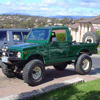
Wanting to get "maximum droop" doesn't have anything to do with the shocks. In the leaf cars I setup with OME springs, rears up front and slightly extended shackles, there was still near 100mm of unused shock travel at full droop. Leaf sierra's just can't use 11" of travel, especially on the rear where the motion ratio is low.
If you flex your car up and measure how much actual shock travel you need, I bet it's not over 8" front or rear.
to give you an idea of how impractical N76's are, (and the compromises we were willing to make to run a shock that was correctly valved for a Sierra, here's some installs from way back in the sands of time:
Here is the most travel I've ever been able to use on an N76 - basically all 11".

This was because we moved the lower shock mount up onto the top of the axlehousing to get it as far out as possible. This was deliberate - the further outboard the lower mounts are, the better the shocks are at stabilising the vehicle and fighting body roll. However, it led to huge front shock towers:
You can see how high they are in the engine bay here:

And that was in a car with a 2" body lift AND 2" bump stop spacers. with neither of those things those towers would be 4" higher in the engine bay.
This car could also use full travel in the rear, but that was with springs that were something crazy like 10" longer than stock and extremely long shackles,

The top shock mounts were hard up under the tray.
Here's a more conventional installation in the front:

and it did use stock lower mounts, but because of the bulk of the shock, any axle wrap would cause the axle to hit the shock.
Here's the rear mounts on the same car, which came though the floor 2", again, on a car with a 2" body lift and 2" bump stop spacing. So, with neither bump stop spacing or body lift, the shock would be 6" through the floor of the car. Yes, you could lay it over at which point it would be basically useless.

Here's the N76 mounts I built when I coiled the rear of my car. Obviously, this isn't practical for a full bodied car and the shocks were only OK like this because the car was radius arm. When I swapped the rear to 3 link the shocks did not provide enough damping in that position and the car was very unstable.

to give you some reference on relative lengths, here's a comparison:

From top to bottom:
Stock sierra front
Stock sierra rear
Rancho 99010 (10" travel, generic soft valving)
N76
OME 80 series front (not recommending it, just there for comparison)
and here:

Left: 12" travel 5125
Right: N76
you can see the bulk difference. Also, note that because they're a monotube, the Bilsteins mount body up, which means only the shaft is down at axle level which really improves packaging issues.
Two drawbacks for 5125's, both associated with them being monotube:
They aren't very efficient lengthwise - i.e a 10" travel monotube is longer compressed than a 10" travel twin tube, foam cell or remote reservoir shock. That's because there's a floating piston in the end of the shock that separates the gas and the oil.
Also, because they're monotube (i.e single wall) if you dent the body, they'll jam up. The body is cromo and much thicker than on a twin tube shock, but it's something to be aware of.
5125's are available from low range offroad, shock warehouse and lots of other places on line. I've also seen them on amazon with free shipping if you're an amazon prime member. Price is around USD $100 each + shipping so depending on how you get them here they're line ball with N76's.
Check part # listings, not everyone carries every valving configuration in every length. if the car is leaf sprung you want the 170/60 valving
Here is the full part # listing:
https://www.shockwarehouse.com/site/bilstein_5125.cfmHappy to provide more assistance with your setup and what you want to achieve, but my advice is don't go overlength with shocks - it creates a tonne of work for no gain.