Here's how I would approach that - crude but generally quite effective ...
Pull a spark plug, pull the coil HT lead to the distributor from the distributor, connect it to the plug and ground the plug
Pop the top off the distributor, connect the test light between ground and the contact breaker terminal on the distributor (or the coil negative) and switch the ignition on, if the lamp does not light check the contact points, they may be closed, flip them open with a small screwdriver and the lamp should light when the contacts are open, if the lamp does not light, move the lamp back to the coil positive and ensure you have power there. If the lamp lights on the coil positive but not the coil negative, the coil primary is open circuit, or the points/condenser may be shorted, disconnect them one by one to confirm and replace if necessary.
We should now be at a point where the test lamp is wired to the contact breaker or coil negative and lighting, rotate the crank until the contact breaker closes and the light goes out, disconnect the light from the contact breaker, and flip the points open using either a plastic tool or a screwdriver inserted between the cam follower on the breaker and the cam - you should have a spark from the coil HT every time the breaker points open, if it is sparking at the points but not the coil HT, replace the condenser.
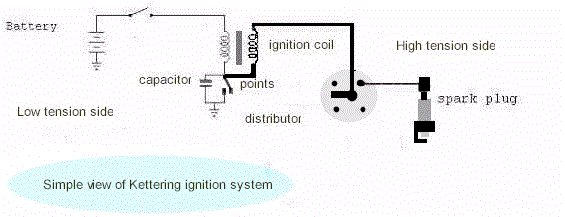
This is just a random diagram pulled off the interwebs, but it'll do for the explanation - capacitor is just another name for condenser.
Current flows from the battery, through the switch through the coil primary, through the points back to the battery - it builds up an induced magnetic field in the coil - when the points open, the current flow stops and the magnetic field collapses generating the high voltage in the coil secondary which is distributed to the plugs, the condenser acts as a tiny battery that, so to speak, hastens or helps the magnetic field collapse faster, creating a hotter spark.


