So I've started a RUF thread. I'm not sure there's really a dedicated thread about doing it. This is in response to this thread:
viewtopic.php?f=5&t=57314 where seanzook06 has touched on RUF bracketry as part of bar design.
Please chime in with any RUF experience/build photos etc you have, let's build a bit of a resource.
Much like a recovery point, RUF is a super critical modification as failure will result in loss of control of the vehicle. It's why engineers pay a lot of attention to chassis welding and design when you discuss RUF and want it legal.
These aren't the only way to do RUF or are any of them the "right" way - they are just what the owner or engineer demanded
This is Gregc's build from 2004/2005. This was a 100% road legal, (other than tyres) engineered build. RUF/narrow tracked spring width, 2"BL, bump stop spacing, massive guard work to run 35's, pinched nose. It was a very thorough build and took 2 years of concerted effort.
Here is the extension. I can't recall exactly how big we made it, maybe 70mm over standard, too much by today's standards, but it doesn't matter if the extension is 10mm or 300mm, it has to be done the same way because you're extending a chassis.
The engineer insisted on doubling plates, fitted internally and extending at least 300mm and plug welded to the existing chassis 300mm wasn't possible due to the shape of the chassis, so it was agreed to make them as long as possible. The cut had to be at 45˚ External doubling plates are possible but in this instance they would sit over the chassis number, mess with radiator mounts, steering box etc. All steel could not be more than 50% thicker than the standard chassis. it's all 3mm in this case (stock chassis is 2.5mm)

We moved the steering box forward (this is a Vitara power steering box)
Here is the steering box doubling plate and crush tubes

and here it is loose fitted

and the passenger side, which was much easier with no steering box of chassis number.

ready to weld to the car. The. new crossmember is 1.75" CDS roll cage tube.

Fully welded out

and on it's wheels in January 2005

You can also see we narrow tracked the front spring spacing so the shackle was under the chassis like on an SJ40/SJ50 up to 1987. This helps tyre clearance and lowers roll stiffness, but it also makes the RUF look so much cleaner.
This car is still setup like this and it's been 100% trouble free for all those years. Yes, it was a lot of work but for it to be perfect 17 years later is nice.

[/quote]
Here is a quick and dirty RUF not he Trolley Tug, actually done at the same time but very quickly and without engineering approval to get the car on Adventure Tour 2005 (I think) This car still exists and is now owned by someone else, but is now an off-road car only.
(Actually, here's the two cars side by side in early 2005)

The body mount was worked into the bar work due to the intended tyre size (Q78 - 35.5") because that area always gets messed up with big tyres.

This extension was far too long which has always made the car sit too tall.

You can see the original bumper holes in the end of the chassis, and the old front crossmember hole. This is doubling plated inside on both sides and outside on the top and the bottom. It's much messier to put the springs outboard but we weren't flipping the chassis upside down to move the spring hangers inboard.
apart from being too long, it's been completely solid, but we didn't take enough car designing it for barwork/winch - everything was just welded to the front of the car (We were always in a hurry working on the trolley tug) - you can see we didn't move the steering box forwards.
Problems with this setup were all down to not enough time thinking it through and not enough time to spend on the car. The bar work was a pain as it was all welded in place. Strong, but a pain. it sits too tall. the wide track spring spacing means the rim offset needed to be huge to clear the springs, so the car was too wide, had too much steering kick back and was (*is) hard work to steer as we never spent the time to go power steering. we never put a recovery point on it and whilst it should have taken a winch, we never really tried. Here it was on it's last trip

And here's Jinxy, the car that breaks the internet. (hOw DoEs iT sTeEr It MuSt HaVe No FlEx) This was not engineer approved but again, ran around for years. it ended up looking like a piece of screwed up tinfoil after many, many hard trips and was eventually parted out.

This car was built very very quickly and the build wasn't really photographed. I have just found some photos of it from 2010 when it was being built. That's why the build photos look like they were taken with a potato.
This was designed to have the shortest extension possible, which I think ended up at something like 17mm. This requires a long shackle and that combination makes the car sit very low. This is about the best photo of the configuration. There are some tricks here. The original front crossmember was removed entirely and a new tube was fitted behind the original location, under the radiator. This was so the steering box (Vitara power steer) could be moved well forwards to clear the tie rod at full compression, with no bump stop spacing and with a vitara drop pitman arm. the springs were inboarded. The chassis wasn't extended at all, new shackle hangers were made up that sat the shackle hanger about centred on the end of the original chassis. Bumpstops were vitara.
This is with OME rear springs, 2" shackles with the stock shackle hanger location. The suspension can't work like this - the shackles will invert, but this sort of ride height was our goal (if not lower)

Here is the car on stock WT spring spacing but the new crossmember is going in

If you look at this photo, you can see how short the "extension" is - it's just a little triangular plate to slide the shackle hanger forward. (look at the passenger side hanger)

and here it is testing.

and on a trip

Would I recommend this? no, not really, I think it would be better with a panhard rod as the flatter the shackles get the more the steering will push the axle side to side (a significant problem with Sierras) but it worked. The car was daily driven on 31's for ages and ages with this setup.





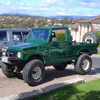


 ) at his place to make a 100mm extension which was far too long, but I think it stayed in the car right up to about 5 years ago when the owner in WA coiled it, I think. Here is a photo of it when it was with it's second owner.


