| Author |
Message |
Boneheimer

az supporter


Joined: Wed Sep 15, 2010 7:50 am Posts: 228 Location: Cairns
Vehicle: 91 Tin Top, 04 Jimny

|
 Posted: Wed Jan 25, 2012 9:01 am |
|
Crimping Vs. Soldering
Had a search on here, found zilch about the pro's and con's.
I've read Symon's electrical and a few other interweb articles, but just wanted some opinions from the auto sparky's and wiring guru's on here.
From what I've read using a eutectic solder will give a good connection, but as your joining all of the wires together you're creating a weak point that's susceptible to mechanical failure.
Also soldering is susceptible to corrosion, although I would have thought double walled heat-shrink with the glue would have created a nice airtight seal that would have stopped this from happening. [Read that the heat from the soldering iron might increase the porosity of the wire insulation???]
On the other hand there is crimping, not using the cheap shitty crimpers, but some good ratcheting crimpers and quality crimps.
These apparently create an almost solid connection as well, although the connection is supported by the crimp itself.
I would imagine that this would create two weak points either side of the crimp, although pretty negligible.
I also noticed that the factory loom uses non-insulated crimps, whether it's because they're superior or cheaper I don't know.
So I was just wondering what those of you in the know, or anyone else for that matter uses or prefers and why?
Cheers 
|
|
|
|
|
Shansh
az supporter

Joined: Sun May 23, 2010 9:35 am Posts: 1816 Location: Goulburn NSW
Vehicle: Ducati Monster
|
Posted: Wed Jan 25, 2012 9:03 am |
|
|
crimps are ok but i prefer solder, you just need to know how to solder properly & use correct solder to avoid hot joints
|
|
|
|
|
Teracis
Joined: Sat Dec 11, 2010 10:03 pm Posts: 2261 Location: Gold Coast
Vehicle: Daisy
|
Posted: Wed Jan 25, 2012 9:20 am |
|
|
As was said in that write up you were referring to if you make the joint reasonably mechanically strong before you solder it, it's going to be a lot better than if it's weak to begin with.
You shouldn't have mechanical load on your wiring anyway, if you do, support it with ties or otherwise in order to remove the mechanical load from the wiring.
Same goes for crimping, you don't want to be using little automotive crimp links and putting mechanical load on them, you can get away with it with more serious types of crimp link or lug as you suggest, but it's still not really ideal.
|
|
|
|
|
atari4x4
az supporter

Joined: Mon Dec 11, 2006 10:30 pm Posts: 34842 Location: East Radelayed
Vehicle: SV420+SV620 Vitara's
|
Posted: Wed Jan 25, 2012 9:27 am |
|
|
both solder & crimping have the place in the automotive industry, you just need to know when & where to use them.
eg, tapping into an existing wire, i'd strip the insulation & solder rather than using a scotch lock (botchlock)
_________________
You're just hating because you don't understand
|
|
|
|
|
3cyl

Joined: Tue Jan 29, 2008 10:30 pm Posts: 2054 Location: Ipswich
|
Posted: Wed Jan 25, 2012 9:34 am |
|
|
I rarely bother soldering connections but in terms of corrosion I guess solder is a little better. You'd be much more likely to get corrosion on an earth lug anyway. Either solder or crimp joints will break where the wire meets the join if subjected to vibration if not supported well enough. The hot melt glue raychem type heatshrink is too stiff when shrunk for my liking.
_________________
awesome only comes in 2 colours, camo & bare metal
|
|
|
|
|
Poita

Joined: Fri Jan 14, 2011 5:03 am Posts: 553 Location: Adelaide, SA
Vehicle: 2010 Suzuki Swift Sports
|
Posted: Wed Jan 25, 2012 9:51 am |
|
|
Totally depends on the application.
I personally like crimping but when tapping into a wire soldering can be better. I only ever use high quality crimps and a ratchet tool.
Never solder AND crimp. Solder 'creeps' I've time and your crimp will fail.
If soldering, make sure its mechanically strong, then solder and heatshrink.
|
|
|
|
|
TasRat

Joined: Mon May 16, 2011 8:00 am Posts: 75 Location: Tassie
|
Posted: Wed Jan 25, 2012 10:06 am |
|
|
New car manufacturers use crimps and I think (someone may know otherwise) aircraft will not use solder, the main reason to my knowledge is crimp and plug connections are less likely to fail due to the fracture of the conductor at the point where the solder stops and the standed conductor continues, a crimped conductor tends to flex over a greater distance at the junction and is therefore less likely to stress and break due to vibration.
The off the shelf faston or spade lug / crimp lugs we tend to use do become loose or corrode.
Many frown upon soldering in cars, however as others have said if soldered correctly and supported so flexing takes place away from the joint soldering can be a successful, I tend to solder when the joint is not likely to need separation in the future.
Never solder a wire and then crimp to another, over time you will get "solder creep" resulting in a loose joint.
|
|
|
|
|
GRPABT1

Joined: Mon Nov 19, 2007 10:30 pm Posts: 731 Location: Townsville
Vehicle: 88 SWB WT Sierra soft top ute
|
Posted: Wed Jan 25, 2012 10:16 am |
|
|
I like to use crimps when exposed to the elements like wiring in tail lights on a ute tray but in the engine bay in and around looms a good soldered join with good insulation aswell can be neater. Crimps are easy to see the corrosion and just as easy to replace where as soldered joins can cause headaches to diagnose. Two little products I love are liquid electrical tape and vulcanising tape as well, these things do a far better job than heat shrink and electrical tape IMO.
Interestingly my auto leccy mate uses crimps in just about every situation, and he works on filthy muddy mine vehicles which get abused.
|
|
|
|
|
bakerboy

Joined: Sun Oct 25, 2009 10:30 pm Posts: 2291 Location: Perth
|
Posted: Wed Jan 25, 2012 10:39 am |
|
|
crimps with leccy tape or heat shrink
|
|
|
|
|
azloki
Joined: Sat Aug 27, 2011 9:01 am Posts: 65 Location: St Marys, NSW
Vehicle: 91 sierra swb nt
|
Posted: Wed Jan 25, 2012 11:08 am |
|
bakerboy wrote: crimps with leccy tape or heat shrink
+1
|
|
|
|
|
MacDaddy
az supporter
Joined: Thu Mar 26, 2009 10:30 pm Posts: 10453 Location: Perth, Australia
Vehicle: Jeep
|
Posted: Wed Jan 25, 2012 4:22 pm |
|
azloki wrote: bakerboy wrote: crimps with leccy tape or heat shrink +1 + 2
But dont use the cheap crimpers that come with some crimp kits, they are shite, and i have had wires come out of the crimp... get a good quality crimper, i bought a Kingchrome 2 in 1 wire stripper and crimper tool for $30, so much easier and does an awesome job ! 
|
|
|
|
|
Rhinoman
Joined: Mon May 16, 2011 7:03 pm Posts: 686 Location: Brinkworth, England
|
Posted: Wed Jan 25, 2012 5:58 pm |
|
|
Crimps are far more reliable but you do need to have a good quality tool and you must use the right gauge wire for the crimp. In the automotive industry crimp tools are regularly checked on a pull gauge, a crimp is made and literally pulled to a set force to ensure that the wire doesn't pull out.
The quality of the crimp can be important too, there are some cheap crimp connectors that don't have the larger diameter end that crimps down on the insulation and provides strain relief - avoid those.
_________________
2000 Suzuki Vitara 1.6 8V
1986 Suzuki SJ413K
|
|
|
|
|
Scales
az supporter

Joined: Mon May 30, 2011 9:28 am Posts: 2233 Location: Townsville
Vehicle: 03 Jim M13A no-vvt, Vinyl Spec
|
Posted: Wed Jan 25, 2012 6:54 pm |
|
|
coming from an aviation sparkys background i can say that crimps are ok in some situations, but they need to be environmentally shielded correctly (and of course applied correctly) in order to be a reliable connection. That is, generally speaking in the automotive world... heatshrink. This ensures minimal corrosion impact on the crimps themselves. there are a heap of other guidelines that make crimps ok to use (i wont go into, there are literally books and books of wiring standards that i had to adhere to) but needless to say, most of these are NOT adhered to in the automotive world, and I would not use them on my car as the ones available to the public are pretty piss weak in my eyes, and most people dont have the knowledge or training to do the job to a high standard. (anyone can do a dodgy crimp though)
Crimps are in my opinion an electrically dodgy way of completing a circuit. there is an inherent voltage drop over a crimp that is accumulative with the more crimps you use on a circuit (one of the reasons the suzuki's require the headlight harness upgrade). They also damage the wire each time they are used which effects the overall performance of the circuit. and the crimps available to most people will fall apart far easier than a solder join. I also think they look messy also compared to a PROPERLY soldered join (which WONT corrode if soldered/cleaned correctly) and protected with the correct coloured heatshrink.
So long story short, i think crimps have theyre place for bush mechanic style repairs. but I think you should learn to solder correctly... take the time to tin your wires and do the necessary prep work to make the join seamless. and protect it well with good quality heatshrink, no supercheap crap. In some cases I use a glue heatshrink that has a sort of hot glue on the inside of the heatshrink that totally seals the solder join from the atmosphere, so no corrosion and supports the wire so well its almost like the join wasnt even there. It may take an extra 5 mins to do each connection but the end product is SOOO much better looking and will last a lifetime. having half a dozen crimps hanging out of the loom is pretty unattractive.
One more point, in both cases the job is pointless unless the harness/loom is routed in a manner that protects your work. IE. no hard radius bends, properly supported harness with clamps/straps/zipties/whatever. Avoid sharp edges and use spi-wrap if you cannot avoid these edges, its amazing how quick and edge can slice your wires with vibration.
FYI im talking crimps as in in-line crimps for splicing in wires etc. I still use lug crimps and plug crimps for end-terminations for earth points etc. Occasionally i will solder these depending on the situation.
one more thing. hypothetically, would you think electricity would prefer 2 pieces of conductor welded together? or just riveted? and whats stronger out of the 2?? food for thought....
|
|
|
|
|
Gwagensteve

Joined: Thu Feb 26, 2009 10:30 pm Posts: 13007 Location: Melbourne
|
Posted: Wed Jan 25, 2012 8:30 pm |
|
^ FTW :armsup:
Scales, thanks for writing a response that I couldn't be bothered to do.
I can't really think of anything to add to that at all, except if you want to take on projects where you think soldering is required/beneficial, use a good quality iron.
I use one of these:
http://www.testequipmentdepot.com/welle ... /wes51.htm
A hand-me-down from Dad, who has been an electronics tech for 40+ years. I think he's used Weller Irons for pretty much all that time.
These are a pleasure to use. Using a crappy iron is like using a cheap crimper - the end result will be unreliable, using it will be frustrating, and you'll try to avoid using it.
Steve.
|
|
|
|
|
sleeperzook

Joined: Mon Jul 06, 2009 11:30 pm Posts: 208 Location: Adelaide
|
Posted: Wed Jan 25, 2012 8:54 pm |
|
Gwagensteve wrote: ^ FTW :armsup: Scales, thanks for writing a response that I couldn't be bothered to do. I can't really think of anything to add to that at all, except if you want to take on projects where you think soldering is required/beneficial, use a good quality iron. I use one of these: http://www.testequipmentdepot.com/welle ... /wes51.htmA hand-me-down from Dad, who has been an electronics tech for 40+ years. I think he's used Weller Irons for pretty much all that time. These are a pleasure to use. Using a crappy iron is like using a cheap crimper - the end result will be unreliable, using it will be frustrating, and you'll try to avoid using it. Steve. x2. Like Scales im an avionics tech. I see soldering (when done correctly) to be the best solution but that requires skill and a good iron. The secret to a mechanically strong joint that is resistant to corrosion and fracture is correct temp control and thorough cleaning. This cannot be achieved with the average dick smiths iron that has 2 speeds, nothing and flat out.
I too have to comply with a lot of standards for aviation. They make sense due to the vibration and heat cycling aircraft experience but for an automotive application its probably over kill unless you observe things like drip loops etc that the rest of the standard wiring will not have, so whats the point? My main issue with in line crimps is their physical size and their inherent corrosion risks. For the average punter with ratchet crimps I'd say a good crimp job is better than a crap solder job. Either way Id suggest good heat shrink to seal, add mechanical strength and always support looms. This will avoid you having to chase corroded high resistance joints that are giving all sorts of issues in a year or 2.
My 2c
|
|
|
|
|
Boneheimer
az supporter
Joined: Wed Sep 15, 2010 7:50 am Posts: 228 Location: Cairns
Vehicle: 91 Tin Top, 04 Jimny
|
Posted: Wed Jan 25, 2012 9:55 pm |
|
|
Hey guys, thanks for all of the responses.
I have access to both a good soldering station and avionics crimps and ratcheting crimpers.
Seeing as there is a voltage drop across the crimps I will probably go the soldering + heatshrink path for splicing and joining wires, and use crimps for terminations.
It was always the plan to support the connections, as it's not very smart to put joints under load, but it was more the constant vibrations that would failure.
Thanks again for all the input!
|
|
|
|
|
jonno_racing
az supporter

Joined: Wed Apr 15, 2009 11:30 pm Posts: 8164 Location: Tassie
Vehicle: suzuki
|
Posted: Wed Jan 25, 2012 10:19 pm |
|
|
i have pulled many a suzuki loom apart... all joints are soldered from the factory!!
i solder all my joins with a gass torch and heatshink, with a generous amount.
this is with all my engine conversions etc.
_________________ Do cool stuff, Put it on the internet Sierra build, Jimny build https://www.youtube.com/user/redzook1
|
|
|
|
|
Reubs

Joined: Wed Sep 09, 2009 11:30 pm Posts: 1522 Location: Brisbane
Vehicle: SJ80, SE416
|
Posted: Wed Jan 25, 2012 10:57 pm |
|
|
I'm going to mention I prefer crimped connections on my vehicles. A PROPERLY crimped connection is electrically as good as a soldered connection.
This is coming from an industrial electrical background. All connections made in commercial and industrial switchboards are crimped and must be vibration (yes large switching components will shake a switchboard) and corrosion resistant for a 30+ year service life in harsh environments.
Crimped lugs are used on cable as small as 0.5mm^2 up to 630mm^2 at which point the smallest added resistance to the joint could result in catastrophic failure - resistance measurable in micro ohms.
The trick is to used good quality crimpers (the crimp tools where I work are 'calibrated'/checked on a regular basis - no cheap ones either) and using the correct size crimp or lug for the cable with the proper technique.
|
|
|
|
|
Scales
az supporter
Joined: Mon May 30, 2011 9:28 am Posts: 2233 Location: Townsville
Vehicle: 03 Jim M13A no-vvt, Vinyl Spec
|
Posted: Wed Jan 25, 2012 11:46 pm |
|

Should be aiming for the image on the right for your end-terminations btw.
Left hand is adjusted wrong, also make sure you have visible strands EXTENDED as is the case on the right, left isnt exposed enough.
Quote: A PROPERLY crimped connection is electrically as good as a soldered connection.
agreed, but a soldered one is neater and easier to get a good/better connection in my eyes. and 9/10 people would let a crimp through even if it werent perfect, making the crimp > solder argument moot.
|
|
|
|
|
ajsr
az supporter

Joined: Sun Dec 28, 2008 10:30 pm Posts: 3712 Location: melb
|
Posted: Thu Jan 26, 2012 12:42 am |
|
|
nearly every connection problem Ive seen over the years has been from crimped terminals. Agreed likely they were not done properly but still
I'll keep soldering my stuff
|
|
|
|
|
Rhinoman
Joined: Mon May 16, 2011 7:03 pm Posts: 686 Location: Brinkworth, England
|
Posted: Thu Jan 26, 2012 11:14 am |
|
jonno_racing wrote: i have pulled many a suzuki loom apart... all joints are soldered from the factory!!
Internally they are solder joints but the loom is well wrapped and the joint is well supported and unable to flex, the connectors are all crimped.
_________________
2000 Suzuki Vitara 1.6 8V
1986 Suzuki SJ413K
|
|
|
|
|
Scales
az supporter
Joined: Mon May 30, 2011 9:28 am Posts: 2233 Location: Townsville
Vehicle: 03 Jim M13A no-vvt, Vinyl Spec
|
Posted: Thu Jan 26, 2012 7:27 pm |
|
Rhinoman wrote:
Internally they are solder joints but the loom is well wrapped and the joint is well supported and unable to flex, the connectors are all crimped.
this is pretty much what you should be aiming for in your own work.
|
|
|
|
|
jonno_racing
az supporter
Joined: Wed Apr 15, 2009 11:30 pm Posts: 8164 Location: Tassie
Vehicle: suzuki
|
Posted: Thu Jan 26, 2012 8:25 pm |
|
Rhinoman wrote: jonno_racing wrote: i have pulled many a suzuki loom apart... all joints are soldered from the factory!!
Internally they are solder joints but the loom is well wrapped and the joint is well supported and unable to flex, the connectors are all crimped. if you call 2 layers of elecki tape in the loom under 2 layers.. so exactly as mine end up _________________ Do cool stuff, Put it on the internet Sierra build, Jimny build https://www.youtube.com/user/redzook1
|
|
|
|
|
neofitou

Joined: Wed Mar 24, 2010 10:30 pm Posts: 1088 Location: Melbourne
Vehicle: 00 Jimny, 63 Haffy
|
Posted: Fri Jan 27, 2012 12:25 am |
|
Anybody been using Solder Sleeves?
I probably wouldnt (I'm exactly with Shakes and Steve),
but I'm interested in how good they really are..

Would be good if your lazy or for stereo stuff.
|
|
|
|
|
got_bar_work

Joined: Sat May 15, 2010 8:30 pm Posts: 2214 Location: Brisbane
Vehicle: SQ625
|
Posted: Fri Jan 27, 2012 12:39 am |
|
|
I gave up on stupid insulated lugs and started soldering on the spade terminals and heat shrining
Any thing ring I use crop lugs
0-6 I use my indent hand criper
6-16 my big hex hand criper
Over 16 I use my 12 ton cordless crimper
Any joins in wire I always solder and heat shrink
If I could find relays with screws I would never use shity spade connectors again
Evey fault I've found in cars has been a spade connector
|
|
|
|
|
Ben_Sierra
az supporter

Joined: Wed Sep 30, 2009 11:30 pm Posts: 4472 Location: Perth
|
Posted: Fri Jan 27, 2012 1:15 am |
|
Crimping? Soldering?
Pfft.... Twist and tape FTW! _________________ I want my old sig back 
|
|
|
|
|
BlueSuzy
az supporter

Joined: Sun May 04, 2008 11:30 pm Posts: 9716 Location: NSW
Vehicle: SJ51 LWB, SJ70 SWB
|
Posted: Fri Jan 27, 2012 1:22 am |
|
Ben_Sierra wrote: Crimping? Soldering? Pfft.... Twist and tape FTW! Thats how my cdplayer was done once on my 1st car .. _________________ BlueSuzy wrote: I'm over the G16b's.
|
|
|
|
|
jonno_racing
az supporter
Joined: Wed Apr 15, 2009 11:30 pm Posts: 8164 Location: Tassie
Vehicle: suzuki
|
Posted: Fri Jan 27, 2012 1:46 am |
|
BlueSuzy wrote: Ben_Sierra wrote: Crimping? Soldering? Pfft.... Twist and tape FTW! Thats how my cdplayer was done once on my 1st car .. i will be honest.. that's how the uhf is in my jimmy atm... bloody solder grew legs and i haven't had the iron out again to do it properly! i will this week as i am doing a gti loom for a mate.. however i twisted and heatshrinked it...
i will post up some pics of how i do connections for looms latter this week, i honestly can not see them failing. _________________ Do cool stuff, Put it on the internet Sierra build, Jimny build https://www.youtube.com/user/redzook1
|
|
|
|
|
Scales
az supporter
Joined: Mon May 30, 2011 9:28 am Posts: 2233 Location: Townsville
Vehicle: 03 Jim M13A no-vvt, Vinyl Spec
|
Posted: Fri Jan 27, 2012 2:58 am |
|
neofitou wrote: Anybody been using Solder Sleeves? I probably wouldnt (I'm exactly with Scales (FIXED) and Steve), but I'm interested in how good they really are.. Would be good if your lazy or for stereo stuff. These are actually a version of a product we use in the aviation industry. They worked quite well, dunno how the knock-offs fare.
the problem was when i took some home to try was that everyday wiring insulation is too pissweak to handle the temperatures required to get the solder to melt and bond the conductor. so youd end up with a solder join sure, but a nice melted bit of wiring also. Aircraft wiring insulation can handle the heat a LOT better.
I saw them in Jaycar the other day but couldnt be arsed giving them a go. My advice is to do it on a test join to see how the insulation holds up.
Things to look for in the solder sleeve:
*Preparation is king, clean insulation removals, if you are twisting the conductors together do it so it looks nice and smooth, no sticky-outy-bits. It doesnt necessarily need to be really tight twists or anything, remember solder needs to get right into the cores for a nice bond. This is paramount for a nice finish.
*COMPLETE absortion of the solder collar into the conductor and no discoloration of the residual flux
*Slight "ooze" coming out each end of the environmental sleeve, this is a gluey sort of compound to seal the join, dont touch it just let it dry
*even, smooth shrinking of the sleeve as a whole, best to use a heatgun with a hook shield (pic below) to achieve best results. they work a treat to protect the rest of the harness in-situ also

*no damage to the insulation
and i hope it goes without saying, NEVER just use a lighter on one of these. heatgun all the way. i would probably steer clear of butane torches also due to their shonky temp control.
FYI below is a pic of what i used to use in aviation, not a fantastic example but you can see what you need to lookout for.
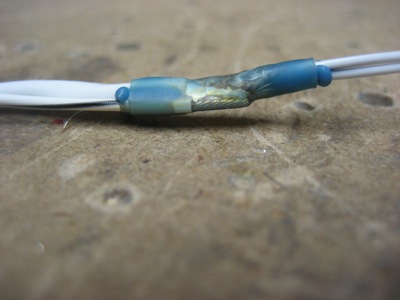

You can see the red band on the solder collar is the flux component, it should completely be absorbed by the conductor/solder (flux is the corrosive element in soldering, should be cleaned away when possible)
and this is what at a minimum i would expect it to look like with an automotive solder sleeve. not as well protected environmentally, but still a pretty decent job of it, im not a fan of the discoloration of the conductor in this pic but im a bit of a perfectionist when it comes to my soldering.
It almost looks like there isnt enough solder in this example and i would have snipped off a tiny piece of solder to put in the sleeve to help out before heating it up.

Let me know how you fare if you decide to use the solder sleeves but do a few practice runs 1st. Id be VERY interested to hear how they go on a regular harness RE: insulation melting.
|
|
|
|
|
atari4x4
az supporter
Joined: Mon Dec 11, 2006 10:30 pm Posts: 34842 Location: East Radelayed
Vehicle: SV420+SV620 Vitara's
|
Posted: Fri Jan 27, 2012 3:08 am |
|
|
:goodtech:
_________________
You're just hating because you don't understand
|
|
|
|
|
|


