sando wrote:
Steve new mil spec Gwagon's have panel filters, surely these are designed for dusty conditions? I was reading on another forum about how panel filters can work well as long you slow the air flow down to about 3m/sec so surely it can work well as long as you can slow the air down enough. In saying all this I do run a rodeo centrifugal filter after my donaldson prefilter...
I'm sure it's possible to make a panel filter work, but there aren't many examples of panel filters being used in a vehicle application where high dust levels (and sensible service intervals*) are planned.
*And that's a big issue. Many people cite the use a panel/foam/gauze/pod filters in various racing applications as proof they bring the awesome and must be the best thing ever. Service intervals on filters in race applications are measured in minutes to hours, and engine rebuild intervals might be measured in tens of hours, not thousands of hours. The engine will generally break from stress before the dust it's eating has the chance to wear it out. That's the nature of the race environment.
Also, few race applications see really heavy dust, and guess what you find when you are looking at race cars that
do see heavy dust:
One, or two, of these

Nice

see the
massive filter housing under the spare tyre?

How about two?
Which are an alloy (and therefore light weight) copy of an donaldson cyclopac:

and contain a paper filter and centrifuge insert.

Anyways, back to the Gwagen thing.
My 1985 Gwagen has a centrifugal filter (it even has a tell-tale for when to service it) but the Gwagen engine bay is pretty crowded, and was never intended to fit a V motor. With the current V6 diesel in there, my guess is space for an adequately large centrifugal filter couldn't be found.
These photos seem to confirm it.
Here's a G350 CDI engine bay

and here's a 300GD engine bay

Not a great photo, but you can see how much breadth the V6 diesel is taking up, and also consider the filter would have to flow twice the air the 300GD filter was designed for.
Also consider that AFAIK, the australian Gwagens have to be road legal (unlike, say, the US army and their Hummers) so the emissions/ADR approval process would become quite costly if a new air filter arrangement had to be engineered. It's far easier to spec a shortened filter replacement interval then it is to try and engineer a better filter into a tight engine bay that isn't required.
Take as another example of the same thinking the wheel and tyre choice - alloys and BFG all terrains are hardly the best choice, but they are relatively cheap, ADR legal, and appropriate for what is a general purpose vehicle, not a front line vehicle.
The Canadian army specced their Gwagens as front line vehicles, and as such they are able to be fitted with armour, and run a MUCH more serious wheel any tyre setup
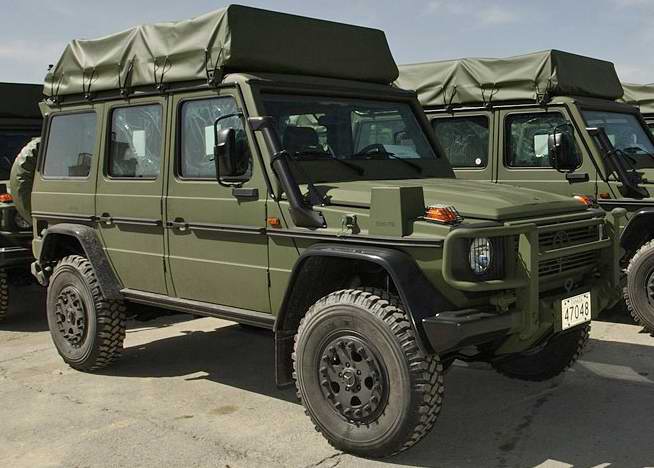
They're Hutchinson double beadlocks (run-flat) with 8.25X16 Michelins (34" tall)
Note that they also run snorkels, not even fitted to the Australian vehicles at manufacture.
So like everything, I'm going to suggest that the spec of the Australian Army Gwagens is a compromise based on cost, use, and subsequent legal resale. It's not the ultimate.
as an aside, note that the army's frontline wheeled vehicle, the Bushmaster, runs a.... wait for it..... donaldson Cyclopac. It's behind the panel with the chain hook hanging off it in this photo. (I've worked on Bushmasters on the production line, which is why I know)

Steve.