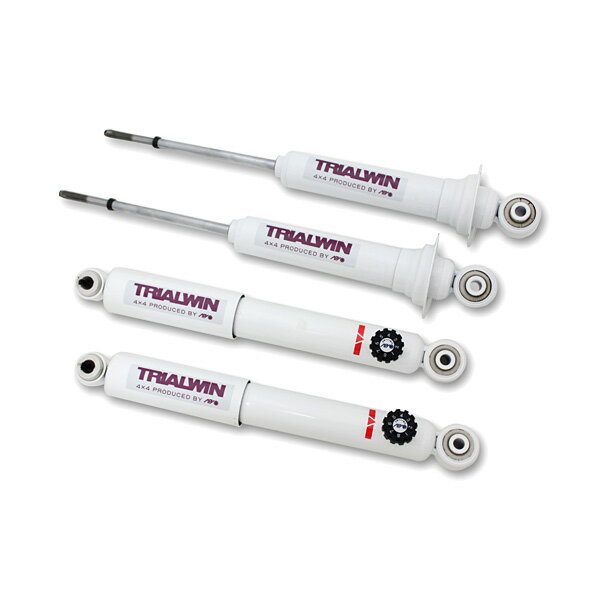
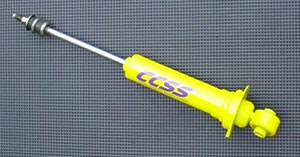
I have searched the forums and there is a lot of informations, but I struggle to find if stock KYB shocks and struts will work with 30mm raised KING springs? I have asked ebay seller and he claim that this will work better than Ultima/KING setup. I failed to see how the non-raised strut will provide 30mm lift with just longer spring?
There is no such thing as a shock for a 30mm lifted spring. The KYB shocks will work fine with King springs and are likely to be much better quality to the ultima shocks
Thanks for the answer. I am not expert on suspension, asking because I was reading this thread and everyone were suggesting to get longer front struts suitable for longer springs. viewtopic.php?f=5&t=6850
So I can order the KYB & KING combo without worries?
I don't think I explained myself the first time, I was on my phone and don't tend to post longer posts on it.
The working range of the suspension isn't changed when lift springs are fitted, only the rest position of the car within that working range.
The length of a shocks you can fit to a car have absolutely nothing to do with spring lift, they are a function of the design parameters of the suspension. All over everywhere you will find reference to "2 shocks" or "shocks for XXmm lift" and there is 100% no such thing.
The shock length is limited by the distance between the mounts at full compression, when the axle is very hard on the bumpstop, minus about 25mm for safety. t
This isn't a negotiable number - if the shocks are longer than this, damage to the car or shocks is possible regardless of the springs fitted.
But, if a shock was going to be 30mm longer extended, it must be 15mm longer fully compressed. That 15mm has to go somewhere.
Some, suspension manufacturers might reduce the safety margin by 10mm.... but... most internal components on aftermarket shocks are bulkier than standard, so even to maintain standard travel and extended length, lots of aftermarket shocks are actually longer compressed than standard.
So, it's extremely unlikely that those KYB shocks are longer than standard, and it's extremely unlikely that any aftermarket shocks are longer than standard. That's normal, because if they were substantially longer than standard, they'd require modifications to bumpstops or shock mounts.
I know this doesn't directly answer your question, but it sort of answers almost every question about every bolt in shock with XX lift height for every car.
If you're across this, you'll know that 30mm of spring lift will work with any strut/shock which fits your car standard.
Joined: Sat May 15, 2010 8:30 pm Posts: 2214 Location: Brisbane
Vehicle: SQ625
Posted: Tue Jul 12, 2016 11:17 am
I would be cutting the tower off and extending it before i would be using bump stop spacers. Adding a bumpstop spacer would eat in to the tiny amount of up travel it alreay has. I always wanted to just cut the towers off and weld on some coilover towers and brace and just run offthe shelf 8in coilovers
Disco, I think you really need to take a step back and analyse what you expect/want the car to do.
The Japanese are really good at making shiny parts but that doesn't mean they're suitable for Australian conditions or necessarily improve the car all that much, depending on what you want the car to do.
There are heaps of poorly devised parts out there for coil sierras. The Coil sierra has very poorly designed suspension and there are lots of compromises that are very difficult to overcome. Just because a part or kit is available doesn't mean it's well thought out.
Take this for an example.
This has to be the worst idea of the lot. A coil sierra has excessive front roll stiffness standard. This kit will do nothing to reduce front roll stiffness (in fact it will likely increase it) and will dramatically lower rear roll stiffness. That's going to make the car feel terrible on climbs. It will throw front wheels in the air all the time and generally feel like it's trying to drive onto its back door.
Here's another - all those adjustable/disconnectable sway bars - sure they're shiny and give you something to play with, but a Coil sierra doesn't need a front swaybar at all, especially when the car is running stiffer (taller) springs - that's because it already has high front roll stiffness.
Rather than concentrating on shiny parts, I'd start with a performance goal, and assess any parts critically to see if they will advance the car towards the performance goal.
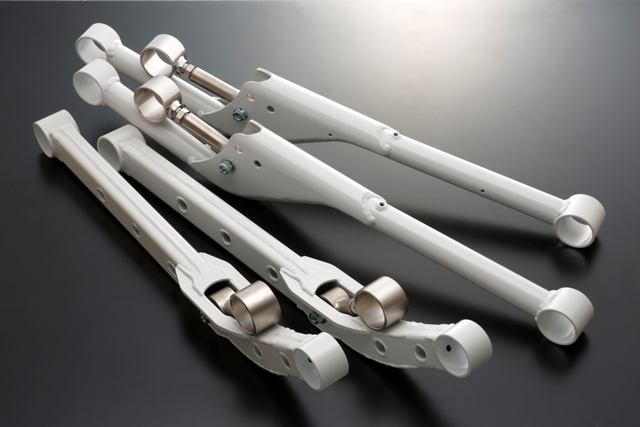
Personally, If it was my car, I'd be less concerned with total travel and more concerned with balance. In my opinion you really want as close to 50% of the flex being done by each axle when you flex the car forwards heading up an obstacle. A stock Coil sierra won't achieve this and in fact, a light rear swaybar might actually improve this. Those flexy white radius arms would help, but I'd only run them in the front. In my opinion you want the attitude of the car to follow its rear axle when climbing.
None of these kits are going to meaningfully improve front wheel travel unless you refabricate the shock tower arrangement. There's little point refabricating the front shock tower without addressing the standard radius arms... and so the vicious circle of Coil sierra suspension commences.
I'm not sure I'd go to coilovers, but I would seriously consider swapping the chassis brackets to Jimny brackets. This gets you away from the factory strut arrangement so you can deal with shock and spring travel separately. This is obviously a fabrication job but at least its cheap. I'd do very little to improve rear wheel travel.
Joined: Sat May 23, 2015 8:50 am Posts: 82
Vehicle: sj80
Posted: Wed Jul 13, 2016 8:18 pm
So Steve, could you illustrate why the coily has such terrible travel?
I understand: Trailing arm is too short/poorly angled for lift over 2" Strut housing is prone to breakage. It's coil over shock design makes it significantly harder to find options for
But, none of these seem to specifically inhibit travel/flex?
Quote:
Personally, If it was my car, I'd be less concerned with total travel and more concerned with balance. In my opinion you really want as close to 50% of the flex being done by each axle when you flex the car forwards heading up an obstacle. A stock Coil sierra won't achieve this and in fact, a light rear swaybar might actually improve this. Those flexy white radius arms would help, but I'd only run them in the front. In my opinion you want the attitude of the car to follow its rear axle when climbing.
That sounds useful and important, but 100% over my head. "Attitude of the car", "50% flex by each axle", the only thing I understood was about those radius arms, but if the car doesn't need a sway bar, then why is it there?
My goal, as stated in my build thread, is to respect the original intent of the car, but acting like the Sierra cost double what they charged. I want minimal custom work, this car isn't about flex, lift, power, traction, or even style. It's about building a pure fun off-road weapon. Think an 86 with 4wd.
Which is why I'm here as I'm beginning my suspension adventure with coils. I fitted off the shelf kings springs, but it lifted my rear well over 2" (soft top + no load), so after chatting with the bloke at suspension city, I'm going to get some springs made to my spec.
The rear springs (HD) have a spring rate of 145lb/in, which is 2.54 N/mm. I'm probably aiming for 2.2. Is there a particular reason why lifted springs tend be stiffer? Wouldn't they be softer as they have a greater working range?
Joined: Sat May 23, 2015 8:50 am Posts: 82
Vehicle: sj80
Posted: Thu Jul 14, 2016 10:34 am
So after a few hours of studying coil suspension I'm starting to see some flaws in the suspension geometry.
Total vertical movement of front axle is actually quite good, but in an effort to stop roll, they have destroyed its ability to flex.
The bush and trailing arm design massively restricts flex potential, with no specific allowance for it besides the inherent flexibility of the rubber. Without this rubber, such as if it's replaced with stiff bushes, the only thing that allows flex is the bending of the trailing arm itself, and of its mounting points. Which is why I believe people seem to believe they're weak, but they're simply not designed to deal with this.
And I'm assuming the sway bar is acting more to protect these components then to actually limit roll, which is why it could be seen as unnecessary.
So would articulating trailing arms (the two halves can rotate independently) significantly boost flex?
Sort of. Remember that when on level ground the standard arms and bushes match the travel of the standard springs and shocks. It's not possible to significantly increase shock travel because of the design of the mounts and the limitations of coil spring design, therefore making the arms flexible will reduce roll stiffness, which doesn't mean there's an outright increase in flex.
Vertical travel isn't anything to write home about. It's about 6".
So roll is front and back axles having same wheels up/down, flex is the opposite. So, FR up, FL down, RR down, RL up.
The coily is very resistant (especially on front axle) to having the wheels at different heights is what I was trying to say, but I was looking forward to you explaining some of the things you meant Steve, I still don't understand the 50% thing, and a few of your other points?
OK, I finally have some time in front of a computer.
DiscoS wrote:
So Steve, could you illustrate why the coily has such terrible travel?
Sure. It's not related to any of these things:
Quote:
Trailing arm is too short/poorly angled for lift over 2"
EVERY 4WD ever made has "poorly angled radius arms for lift over 2". That's because the car isn't engineered to be 2" taller than the manufacturer intended.
Quote:
Strut housing is prone to breakage.
Yes, it's under engineered.
Quote:
It's coil over shock design makes it significantly harder to find options for
This is also true but it's not why it lacks travel.
Quote:
But, none of these seem to specifically inhibit travel/flex?
No they don't individually, but they sort of add up to that result . What limits travel is that Suzuki designed the car for 6" of front travel, the same figure as a leaf Sierra. However, it's relatively easy to increase travel in a Leaf sierra - leaves with more camber can be fitted, and with some changes to bumpstop position shock mounts and shock length, (not even to mention RUF) it's possible to fairly significantly increase travel AND flex. (these are two different things and are only fleetingly related)
However, for a coil sierra. It's very difficult to fit a longer shock absorber. That's for a few reasons. The coil seat is one reason - it needs to be welded or otherwise attached to or around the shock. The coil tower won't clear a larger diameter shock, and most aftermarket shocks are larger in diameter... and then, critically, Suzuki designed the spring for 6" of travel. There are two critical parameters for a coil spring - rate and collapsed length. If you add rate, you'll add height, but you also need to keep collapsed length the same as standard, or you'll need to add bumpstop spacing. Many 2" lift springs get around this problem by being short - in some cases, shorter than the factory spring - they have more rate so you get lift, but you add no travel by fitting them. This is the reality of trying to design springs to fit within factory parameters to do a non-factory job.
The solution to this is to move the coil tower up so you can fit a spring that's longer collapsed. This means its possible to design a spring that's longer free (open) and has a low rate.
This is the work required to add travel - longer shocks and longer springs. That's not the same as lift springs or "2" shocks" which have nothing to do with increased travel.
Now, there's another big critical variable.... and it's this:
Quote:
That sounds useful and important, but 100% over my head. "Attitude of the car", "50% flex by each axle", the only thing I understood was about those radius arms, but if the car doesn't need a sway bar, then why is it there?
It's roll stiffness. Roll stiffness has nothing to do with travel (nothing at all) and to understand what it effects.
Roll stiffness is the freedom for the axle to articulate under the car. It's a little bit associated with spring rate, but it can be very associated with the link configuration. Radius arm cars have high roll stiffness. That's because, as you've learned, you have to squish the bushes a lot to make the axle flex. This is like having extra stiff springs, but only when you flex the car, not when you hit a bump square on. It doesn't matter how you mess with springs and shocks, the radius arm design will always be fighting the car flexing. Now, there's an interesting thing going on with the Coil sierra - the rear springs are inside the chassis rails, so they have little effect on roll stiffness, but the front springs are outboard of the chassis, much closer to the wheels. This adds roll stiffness to the front.
It's quite possible to have lots of travel but very little flex with a radius arm design. The front of GQ patrols are particularly bad in this regard.
The effect of high front roll stiffness is that when climbing, the front will always straighten up (or "unflex") and the steeper the hill, and the more spring lift (and therefore rate) you run the worse it gets. And adding urethane caster correction bushes makes it even worse. Obviously the swaybar makes it worse.
So why did suzuki fit a front sway bar? In order to make the car understeer heavily. All manufacturers make their cars understeer because it's safer for inexperienced drivers and Sierras are frequently driven by inexperienced drivers. Also, less body roll makes the car feel more 'car like" but it makes it much harder to judge front tyre adhesion and handling balance.
Quote:
Which is why I'm here as I'm beginning my suspension adventure with coils. I fitted off the shelf kings springs, but it lifted my rear well over 2" (soft top + no load), so after chatting with the bloke at suspension city, I'm going to get some springs made to my spec.
The rear springs (HD) have a spring rate of 145lb/in, which is 2.54 N/mm. I'm probably aiming for 2.2. Is there a particular reason why lifted springs tend be stiffer? Wouldn't they be softer as they have a greater working range?
This is a very common misconception as I've pointed out above. Lift springs are almost always stiffer because there isn't room for a spring that's 2" longer with a factory rate. That would require more turns of wire, and there's nowhere for them to fit when the suspension is fully compressed. When fully extended, a spring that's 2" longer than stock wouldn't be of any help to anyone because there's no room for a shock that's 2" longer than standard extended, and because you need the shock and spring to reach full extension together (to retain the spring and prevent shock damage) it's common for lift springs to be shorter than their quoted lift height extended (and sometimes shorter than standard) and have a higher rate so the car sits higher.
I hope this helps. This is a complex topic where, sadly, marketing and myths tend to be believed as truth.
Joined: Sat May 23, 2015 8:50 am Posts: 82
Vehicle: sj80
Posted: Fri Jul 15, 2016 11:21 pm
Cool, it'll take a while for me to actually comprehend what you've already written 100% but I have heaps more questions if you don't mind..
Where did you find the 6" travel figure? Is that wheel hub travel, or the non-adjusted shock travel? I'm assuming the coily has twin tubes front and rear?
So stock wheel is 26". With 30" wheels I've lost 2"of travel, as the wheel will now impact 2"higher than stock. Greater length extended shocks and springs plus bumpstop spacing would allow me to regain my factory 6" travel correct?
But considering the now larger wheels, and 2" extra in bumpstop spacing shouldn't this allow me to fit a shock with 2"greater compressed length, resulting in an increase to 8" of travel? (Or whatever it works out to be)
About springs, so ALL of the sj80 springs out there are actually the same height, and offering the same travel. Manufacturers alter the spring rate, changing the ride height, but doing nothing for travel except for making the ride harsher. Instead of the stock setup of 3"up and down travel, with aftermarket coils there's only 1" down, and 5" up?
A radius arm that can rotate in the middle of the arm should allow the car to flex significantly greater correct?
Has anyone tried fitting coilovers into the front suspension? They seem to be plenty long, and significantly narrower than other suspension types.
Is the rear setup problematic or has it been engineered better by Suzuki? As in, everybody always discusses front-end issues, so I'm assuming the rear end is easy as to tweak?
Castor, I had believed this was due to arm designs. As the car lifts, the arms twist the axle, unseating the springs or something, is that it, or is there more to it? Does this tie in at all with axles moving rearward causing issues with contact between shocks and springs, or is that unrelated?
Finally,
Quote:
it's possible to fairly significantly increase travel AND flex. (these are two different things and are only fleetingly related)
I don't believe you ever actually explained this, what IS the difference? I believe we've discussing travel this whole time, so what's flex?
Where did you find the 6" travel figure? Is that wheel hub travel, or the non-adjusted shock travel?
It's shock travel. For a live axle suspension with vertical shocks, wheel travel is the same as shock travel.
Quote:
I'm assuming the coily has twin tubes front and rear?
As far as I am aware, yes. This is isn't really relevant at this stage.
Quote:
So stock wheel is 26". With 30" wheels I've lost 2"of travel, as the wheel will now impact 2"higher than stock. Greater length extended shocks and springs plus bumpstop spacing would allow me to regain my factory 6" travel correct? But considering the now larger wheels, and 2" extra in bumpstop spacing shouldn't this allow me to fit a shock with 2"greater compressed length, resulting in an increase to 8" of travel? (Or whatever it works out to be)
Not really. A 30" tyre will likely go very close to fitting with no loss of travel if it's used on the correct offset rim. However, yes, your assumption is correct. If you need to bumpstop space to clear a tyre, that it's possible to fit longer shocks and springs with a longer compressed length to gain more total wheel travel. For when comparing like for like shocks, a shock that's 2" longer compressed all be 4" longer extended. (this isn't true when comparing an aftermarket shock with a factory shock - most aftermarket shocks have bulkier internals and have less travel for the same compressed length than standard, especially monotube shocks.)
Quote:
About springs, so ALL of the sj80 springs out there are actually the same height, and offering the same travel. Manufacturers alter the spring rate, changing the ride height, but doing nothing for travel except for making the ride harsher. Instead of the stock setup of 3"up and down travel, with aftermarket coils there's only 1" down, and 5" up?
I'm not claiming all SJ80 shocks are the same height has factory, but that they will not necessarily be longer. You are 100% correct with the effect on travel though - as you add suspension lift, if bumpstops remain standard and the shock still fits on stock mounts, all you are doing is adjusting the rest position of the suspension.
Quote:
A radius arm that can rotate in the middle of the arm should allow the car to flex significantly greater correct?
Yes. These ideas have been tried many ways over many years with every radius arm car.
Quote:
Has anyone tried fitting coilovers into the front suspension? They seem to be plenty long, and significantly narrower than other suspension types.
I haven't seen anyone do it with otherwise standard coil driveline and suspension parameters - normally but the time you're prepared to pay for coilovers (and work out how to spring and tune them) owners also want to address all the other limitations of the SJ80 so everything gets thrown in the bin. Swapping the spring/shock mounts to Jimny parts allows many more spring and shock options without the expense of coilovers.
Quote:
Is the rear setup problematic or has it been engineered better by Suzuki? As in, everybody always discusses front-end issues, so I'm assuming the rear end is easy as to tweak?
The rear end isn't perfect, but because the spring and shock are separate and roll stiffness is low, its easy to modify. Caster isn't relevant for the rear end so lift has less detrimental effects.
Quote:
Castor, I had believed this was due to arm designs. As the car lifts, the arms twist the axle, unseating the springs or something, is that it, or is there more to it? Does this tie in at all with axles moving rearward causing issues with contact between shocks and springs, or is that unrelated?
There is more to it. Caster is an imaginary line drawn from the centreline of the steering knuckle kingpins to the ground (viewed from the side) if that line intersects the ground in front of the front of the tyres contact patch, the car is said to have positive caster. If it contacts behind the contact patch, it's said to have negative caster. Positive caster is what makes the steering self centre and and car track straight. It also improves turn in. As caster is increased though, steering weight increases, so on manual steering cars, manufacturers use the least caster possible to make the car manoeuvrable at low speeds. However, that means as we lift the car caster becomes inadequate and the car wanders and won't turn in.
So it's the primary concern when lifting the car. The clearance issues are secondary and can easily be overcome.
Finally,
Quote:
it's possible to fairly significantly increase travel AND flex. (these are two different things and are only fleetingly related)
I don't believe you ever actually explained this, what IS the difference? I believe we've discussing travel this whole time, so what's flex?[/quote]
Oh, sorry, yes I realise I didn't discuss this. Travel is the vertical movement of an axle. If you have 6" of travel that might be three up and three down, at the wheel. However, articulation is the diagonal movement of the axle under the car, as occurs when one wheel drives up onto an obstacle. Because the contact patch of the tyre is outboard of the spring, shock or (critically) bumpstop, geometry comes into play, and you get much more flex than you get travel. Imagine this experiment to prove the point: Say we built a car with one spring one shock and one bumpstop on the centre of the axle housing. Travel would be whatever range of motion the spring and shock had. Flex, however, would be theoretically unlimited. With our cars, the further we move the springs and shocks outboard of the centreline of the vehicle, (so the closer to the tyres) the closer the travel and flex figures align. It's part of the reason the rear suspension of coil sierras is less problematic - the springs and shocks are much further inboard, so rear flex can be substantial, even if travel is relatively low.
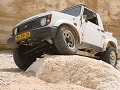
Have a look at Rick Pewe's Jeep in this photo (the middle one) You can see the amount of travel measured at the springs, but the flex is very substantial because of the distance from the spring to the tyre contact patch.
With this in mind, you should be able to see the importance roll stiffness plays in off road capability. A car could have huge travel but high roll stiffness - and it just won't flex. A car with low travel but well positioned springs and shocks can provide very high flex even with very limited travel. Those of us that have worked on extending the capability of leaf sierras move the springs and bumpstops inboard in the front in order to lower front roll stiffness. Likewise, "wristed" or rotating radius arms reduce roll stiffness.
when I talk about 50% of the flex being done by each axle when climbing as a good goal, this is really mostly about roll stiffness. Freeing up the front of the car so it can move when you're climbing is very important. I'll use one of my favourite photos to demonstrate. It's an extreme case, but a good illustration.
I find the easiest way to envisage the effect of something is to exaggerate it. This car clearly has amazing flex. It does also have very high wheel travel, but it's actually unused because it's not sprung - the wheels can just fall away. It has about 2" of sprung compression travel at ride height. What it does have (and why it's relevant here) is very equal roll stiffness and very equal flex front to rear, maybe favouring the front a little when climbing.
If this car had high front roll stiffness, there's a couple of scenarios that would play out here if the car drove into this position. If it was rear weight biased, it might lift that left hand front wheel off the ground, but because of the roll stiffness, because the car is pointing up hill and therefore the weight is transferring rearwards, the front suspension would try and flatten back out and rise up on its springs. This is what most radius arm cars do. This will put the nose the car high in the air and make it feel really spooky. this becomes self perpetuating - the higher the front rises, the more weight transfers rearwards, so the higher the front rises, until the car has no front traction and the rear is just digging holes.
If it was front weight biased with high roll stiffness, it would just roll over onto its side.
Remember, both of these effects are irrespective of travel, only roll stiffness.
My own car on this ramp used to favour the second option - it would follow the nose up to the point I feared the suspension would straighten out and roll the car (as it often did) I fixed this by limiting rear axle flex. (and adjusting rear suspension geometry) and now the car sits much more level on climbs.
Here's my car on the same ramp with the old setup. By reducing rear axle flex I've forced the front to work harder, this has balanced the car and kept the body more level when climbing. This is what I talk about when I talk about "balance" - try to keep the car level and stable is far more important than having high travel or flex.
Here's my total rear flex now. Sadly, I don't have before and after photos from the same point of view. I haven't reduced rear travel, only flex.
In this photo the wheel is off the ground. It wasn't in the other photo n the ramp. It's a substantial reduction in flex I achieved by relocating my shocks outboard.
I know this looks hopelessly complex and irrelevant - these are obviously custom built cars - but the principles are the same. I've used these cars as examples as they exaggerate to prove the point I'm making. Balance and roll stiffness are more important that lift or flex.
Thanks Gwagen. Completely agree with everything said. Thats why my coily throws front wheels in the air all the time. I think this picture explains exactly whats going on in the front. Rear wheels planted on the ground and front just hanging.
Joined: Sat May 23, 2015 8:50 am Posts: 82
Vehicle: sj80
Posted: Sun Jul 17, 2016 12:05 am
I'm glad this is working to help people understand our SJ80s better, and the burdens we've signed up for. I've always felt as if people are telling us how we're screwed, and the suspensions borked, but nobody has ever actually taken the time to illustrate why. I'm actually hopeful through this round-table, I can find some solid, bolt-on, items that I may be able to help produce, or at least design (my 3D CAD skills far out reach my fab skills). Anyways, back to it..
@Green, I take it you're running KYB fronts, Ultima rears, no sway-bar, and King springs? Is there anything else I've missed? What size wheels? Bodylift, effective spring lift? How's ride quality? (highways, corners, parking) Have you broken any trailing arms (mounts)? Can you actually get the whole 6" of travel?
Snake Racing's SJ80 Analysis, At 23 seconds, the nose dives heavily, and the car nearly flips. Is that an example of the SJ80's hate of flex, or something else? In this vid I feel like the car has massively limited travel, with the car barely moving from its static ride height. Could this be due to the springs being too stiff? I'm not thrilled by its performance at all, or is this pretty much as good as can be expected from an SJ80? Are there any relatively stock SJ80s out there out-performing this one?
EDIT: This one seems to be doing pretty well
And this guy:
Japan FTW:
Some random French guy: (pretty sure his setup is completely custom though)
Roll Stiffness, How low can this realistically be and maintain good road-handling characteristics? I'm sure it couldn't maintain OEM road-handling, but how badly would solving roll-stiffness impact cornering?
Spring stiffness, I am now feeling like one of the SJ80's greatest problems is that everybody continues to fit stiffer springs for a virtual lift. An obvious solution to all of our discussed issues is simply to use softer springs, do OEM springs actually flex better? Has anyone bothered to check if their 2" lift and spring kits actually did anything but boost their ride height?
Returning to roll stiffness, obviously spring stiffness feeds into roll stiffness quite a bit, and as I previously asked about how low you can go before it's a hippo, it's pretty obvious this is an area where high and low speed handling does not co-exist. The solution appears to be low-rate, longer springs, coupled with a detachable sway bar, so that when returning to the roads, it can help control roll?
Caster, I feel it's ridiculous that you'd need to buy some arbitrary trailing arm to fix this, wouldn't length-adjustable trailing arms (radius arms) solve this? Or would the radius arms need something specifically to rotate the axle? Would a RTC steering damper help anything?
50/50 Balance, Are other alternatives to acheive limited rear flex: stiffer springs, stiffer bushes, higher damping? What did you actually do to your ride to do it?
Trailing/Radius Arms, Does it need any actual structural strength? As far as I can tell it obviously locates the axles in place. Is it's only extra purpose in an SJ80 to restrict flex / body roll? (arguable if that was on purpose or budget-induced)
Shocks, I'm seriously struggling to figure out what they do, I wholly understand they stop infinite bouncing of the coils, but what else do they do besides limit travel? Do you want high or low rebound or compression damping for 4wding?
Pan(hard?) Rod, While we're at it, wtf does this bad boy even do? I've heard it stops the axles sliding left/right whilst cornering, but why do we need that when we've got such stiff trailing arms? If we can just remove the sway bar, why not these rods? Are they of any benefit whilst low-speed 4wding?
Brake lines, make sure they're long enough Steering thing, make sure it can reach Are there any other suspension-involved parts on an SJ80 that needs to be dealt with?
As you may have picked up, I'm leaning with the trailing arm being my part to design. I'm getting excited that this may be the answer I've been looking for! Once again, my goal here is to retain the SJ80's solid on-road performance, whilst boosting the off-road performance as far as possible, and hopefully keeping it road legal. This looks like the most likely target for some small, popo friendly, gains!
And about this kit (APIO complete 2.5" lift + detachable sway bar) Do you feel like it's the best thing you've seen so far for the SJ80? Is there anything glaring about it that makes it seem like a bad idea / poorly executed? I'm planning on running this setup, and maybe swapping out the springs for a lower spring rate to keep me around 1" static lift to keep popo happy, but still having the extra droop from the increased range / travel this kit hopefully delivers. Also, JDM excites me, and the adjustable damping on those shocks just makes me happy.
EDIT: Also if anybody has any OEM tech specs such as damp rate, spring rate, shock length, diameter, etc.
Ultima front and rear, 40mm king springs that have which sagged to 30mm. Standard bumpstops No sway bar. 235s, no body lift. Ride is reasonable, however it is underdampened so I feel it could be better. I havent measured the travel however the shocks are to suit standard height so all I have effectively done is change the rest position of the suspension.
I broke a rear trailing arm mount as soon as I put a locker in the rear.
How 'bout changing the bushings in radius arms that bolt to the frame to some kind of jonyjoint? Will that give more flex? Or will it lower the front roll stiffnes?
Joined: Sat May 15, 2010 8:30 pm Posts: 2214 Location: Brisbane
Vehicle: SQ625
Posted: Mon Jul 18, 2016 6:40 pm
It wont do anything except add road noise and vibration to the cab. Its the diff end thats the problem. New stronger diff brackets with the holes moved to correct caster is a better idea then offset bushes. They only limit flex even more
Snake Racing's SJ80 Analysis, At 23 seconds, the nose dives heavily, and the car nearly flips. Is that an example of the SJ80's hate of flex, or something else? In this vid I feel like the car has massively limited travel, with the car barely moving from its static ride height. Could this be due to the springs being too stiff? I'm not thrilled by its performance at all, or is this pretty much as good as can be expected from an SJ80? Are there any relatively stock SJ80s out there out-performing this one?
That's entirely normal behaviour for a SWB vehicle. The behaviour of this car in this situation has more to do with wheelbase than any other factor. It was MILES AND MILES from "flipping" The car weight transferred forwards. A leaf sierra would behave exactly the same. Low front roll stiffness will help the front to articulate as the car steps down this sort of thing, but the only real cure is more wheelbase.
Quote:
EDIT: This one seems to be doing pretty well
Impossible to tell - the car is driving downhill which, again, due to weight transfer, will load the front bushes up and encourage the front to flex.
Quote:
And this guy:
Can't really tell from the video. It's certainly very, very tall, typical for NSW cars when that was built.
Japan FTW:
Well that's pretty normal coil sierra behaviour. Note at 2.20 the car rocks quite noticeably whilst the front axle isn't articulating at all. Here is an example of high roll stiffness in the front with low rear roll stiffness (and I'd suggest overly soft shock absorbers)
Quote:
Some random French guy: (pretty sure his setup is completely custom though)
Indeed. There are no SJ80 parts in that car. It's also excessively tall and unloads terribly on climbs.
Quote:
Roll Stiffness, How low can this realistically be and maintain good road-handling characteristics? I'm sure it couldn't maintain OEM road-handling, but how badly would solving roll-stiffness impact cornering?
It depends what you associate with "good handling" If it's flat cornering, then no, low roll stiffness will feel like the car is handling poorly. If it's a much better understanding of how close the front tyres are from running out of grip, and reduced understeer, then low roll stiffness improves on road handling. I don't want to try and make a live axle 4WD handle like a road car because it's misleading - you'll exceed the cars lateral grip without realising what's going on, and breakaway will be sudden. I'd rather have much more warning when I'm pushing through the limits of front end grip.
Quote:
Spring stiffness, I am now feeling like one of the SJ80's greatest problems is that everybody continues to fit stiffer springs for a virtual lift. An obvious solution to all of our discussed issues is simply to use softer springs, do OEM springs actually flex better? Has anyone bothered to check if their 2" lift and spring kits actually did anything but boost their ride height?
You've learned the great truth of 4WD suspension. Aftermarket suspension that fits in otherwise unmodified cars doesn't add wheel travel.
Quote:
Returning to roll stiffness, obviously spring stiffness feeds into roll stiffness quite a bit, and as I previously asked about how low you can go before it's a hippo, it's pretty obvious this is an area where high and low speed handling does not co-exist. The solution appears to be low-rate, longer springs, coupled with a detachable sway bar, so that when returning to the roads, it can help control roll?
I disagree with this. A properly sprung and most importantly damped car won't feel like "a hippo" and it's also not relevant to use the term "high speed handling" in relation to a Sierra. The key issue here is that many people think that a car that's good on road must be bad off road and vice versa. This is not true. On road handling quirks manifest themselves off road too - low rear roll stiffness leads to excessive body roll and understeer on road, and it leads to excessive body roll and loss of front axle traction off road. Inadequate damping makes your car undrivable on AND off road.
Caster,
Quote:
I feel it's ridiculous that you'd need to buy some arbitrary trailing arm to fix this, wouldn't length-adjustable trailing arms (radius arms) solve this?
No. That will have no effect on caster.
Quote:
Or would the radius arms need something specifically to rotate the axle?
Yes. Or caster bushes, which inherently increase roll stiffness.
Quote:
Would a RTC steering damper help anything?
No. It doesn't add caster, it just makes the steering heavy off centre.
Quote:
50/50 Balance, Are other alternatives to acheive limited rear flex: stiffer springs, stiffer bushes, higher damping? What did you actually do to your ride to do it?
Using spring rate to control roll stiffness on the rear of a coil sierra is very inefficient because the springs are so far inboard. By the time you introduced enough roll stiffness to counter the front the car wouldn't have any wheel travel and the ride would be terrible. High damping doesn't increase roll stiffness because dampers don't apply any force, they only damp the force that's already there, so they can slow down the effect but they'll only delay it. Also, in the rear of a Coiler they aren't positioned to have much control over roll stiffness. Increasing bushing stiffness leads to broken diff mounts. ( and it's a very coarse way of tuning roll stiffness) A sway bar can be easily adjustable whilst you're tuning the feel of the car.
The rear is fine if you can lower front roll stiffness.
Quote:
Trailing/Radius Arms, Does it need any actual structural strength? As far as I can tell it obviously locates the axles in place. Is it's only extra purpose in an SJ80 to restrict flex / body roll? (arguable if that was on purpose or budget-induced)
They need enormous structural strength. They are transmitting enormous forces. Radius arms have inherent roll stiffness, it's part of the design and why they are frequently used - they are cheap and simple and easy to package. Some roll stiffness is always required and having radius arms means there is either no or little need for a sway bar. Factory designed Cars with very low front roll stiffness have to have very heavy, high rate sway bars to put it back and provide a "car like" driving experience, because that's what customers now expect. It didn't used to be like that.
Quote:
Shocks, I'm seriously struggling to figure out what they do, I wholly understand they stop infinite bouncing of the coils, but what else do they do besides limit travel? Do you want high or low rebound or compression damping for 4wding?
they stop infinite bouncing of the coils This. This is what they do. A coil spring car with no shocks is undrivable. Really, really dangerous. They are sized to prevent the springs falling out and therefore are tied to the working travel of the spring.
Quote:
Pan(hard?) Rod, While we're at it, wtf does this bad boy even do? I've heard it stops the axles sliding left/right whilst cornering, but why do we need that when we've got such stiff trailing arms?
Radius arms (they are NOT trailing arms) only prevent flex. They are very inefficient at preventing lateral movement - the bushes aren't designed for that. A radius arm car with no panhard rods isn't drivable, the axles will walk left and right under the car until the tyres bind on the chassis or everything tears itseld apart. You'll also ave zero steering as the drag link will just move the axle left and right rather than steering the wheels.
Quote:
Brake lines, make sure they're long enough Steering thing, make sure it can reach Are there any other suspension-involved parts on an SJ80 that needs to be dealt with?
Yes. Springs. The closed and open lengths of the springs fitted to the car are the BASIS of the whole design of the suspension. If you want to significantly change spring free or compressed length you have to start from scratch with the entire suspension design. You also need to comprehend that significantly derating a spring makes the car very sensitive to angles (both side and climbing/ascending) and load. You can engineer that out a bit by raising oll centre, but then you have to contend with lots of lateral movement over bumps and suspension than can "lock up" when close to the adhesion limit on road. This is bad.
Quote:
That photo there is either a 2005 onwards F250 aftermarket arm or a radius arm conversion for the 5 link front on a Dodge Ram. It actually does almost nothing to address the roll stiffness problem. Stare at that drawing and imagine the axle attached to it. Now imagine one wheel up on an obstacle and one wheel down, so the arms are on two different angles. Where is the flex being done? on the same 4 bushes on the axle, just like your coil sierra now. These arms exist in order to adjust caster to compensate for large suspension lifts. that design is not intended to add flex.
Quote:
This is a conversion kit to convert 5 link front ends for Jeeps into a simple radius arm front end. This is not comparable to what you are looking at and will stiff have relatively high roll stiffness. It also requires bracketry on top and under the axle which a coil sierra doesn't have.
Quote:
As you may have picked up, I'm leaning with the trailing arm being my part to design. I'm getting excited that this may be the answer I've been looking for! Once again, my goal here is to retain the SJ80's solid on-road performance, whilst boosting the off-road performance as far as possible, and hopefully keeping it road legal. This looks like the most likely target for some small, popo friendly, gains!
Please take this the right way, I appreciate being able to put some time in encourage Coil owners to understand where there problems are, but I suggest you have a very limited working knowledge of suspension engineering. This is a very complex issue. Parts fabrication is a big issue when the consequences of failure might include the tyres jamming instantly on the firewall at freeway speeds. Anything you devise will require third party engineering approval. You will note we don't have all these custom arms for sale in Australia, and in fact, almost no fabricated suspension arms at all - the Superior legal radius arms are cut from 25mm plate with no welds in them in order to satisfy engineering. Even though my own car isn't engineered, I used off the shelf (rover) radius arms for my car as I wanted to feel comfortable with factory engineering.
If you really want to fabricate suspension parts, forget custom radius arms and convert the front end to three link. Roll stiffness, caster, antidive/squat can all be adjusted then as part of the design instead of trying to workaround compromised geometry and design.
Quote:
And about this kit (APIO complete 2.5" lift + detachable sway bar) Do you feel like it's the best thing you've seen so far for the SJ80? Is there anything glaring about it that makes it seem like a bad idea / poorly executed? I'm planning on running this setup, and maybe swapping out the springs for a lower spring rate to keep me around 1" static lift to keep popo happy, but still having the extra droop from the increased range / travel this kit hopefully delivers. Also, JDM excites me, and the adjustable damping on those shocks just makes me happy.
This kit will not deliver meaningfully increased travel. I believe the reason the bumpstop spacers are fitted is to provide space for the bulky rebound adjustment mechanism in the rear shocks. There might be a small increase in rear droop, but it won't be more than the thickness of the bumpstop spacer. Otherwise, you're paying for lots of shiny things that aren't required. With low lift the adjustable panhards and caster bushes aren't required, nor are the swaybar spacers. The swaybar isn't required at all in my opinion.
All up, an expensive waste of money in my book. If you want 1" of lift, put 1" coil spacers in, run 1" bumpstop spacers and fit a 2" longer shock in the rear. You'll gain travel and flex for almost no money. You won't find softer springs than factory.
If that's not enough, convert the front to Jimny separate shock/coil and apply the same bumpstop spacer/longer shock regime.
How 'bout changing the bushings in radius arms that bolt to the frame to some kind of jonyjoint? Will that give more flex? Or will it lower the front roll stiffnes?
Sent from my SM-G900F using Tapatalk
kenzook wrote:
Disco. You don't need to buy new special arms just for the castor. There are castor correction bushes available.
Epitam. I've asked this before and got told no they don't work that way? I didn't understand why but believed anyway.
Changing the bush at the chassis end will have very little effect. The standard rubber bush in this location is designed to rotate quite freely. The problem is not here, it is the axle end bushes.
It is very common to think the problem is due to the bushes inability to squish diagonally that is the problem. That's not the problem at all. it's This:
when one wheel is up and the other down, the whole axle housing is trying to twist and flex is restricted by the ability of the bolts in the bushes to move off centre. The issue of the bushes being able to twist is a minor problem.
People have discussed adding all manner of high misalignment bushes, but these only ever allow twist. They generally provide no ability for the bolt to move vertically relative to the bush, so they will always jam the suspension up.
Because caster correction bushes have the bolt already offset. there is less space on one side of the bushing for the bolt to move into, so caster correction limit flex and increase roll stiffness.
It was common some years ago for Range Rover owners to drill holes in two of their front radius arm bushes to let the bolt move more freely up and down. These so-called "holey bushes" significantly reduced roll stiffness, but it's obviously possible to have the bushes fall apart together making for a very loose and floppy car.
When my car was radius arm rear ( and leaf front )I took one rear bolt out of the axle end of the radius arm to increase flex and reduce roll stiffness. I did increase flex but it made the car almost undrivable in off camber climbs as the all the torque running through one arm only drove the car over into a huge side angle. for reference though, here's two interesting photos of this experiment.
here it is with all the bolts in. This is radius arm rear with widely spaced arms, so high roll stiffness. The (leaf) front end is being forced very hard because the rear doesn't want to flex, so the body is sitting quite level.
And here's what happens with almost no rear roll stiffness. (Obviously, the front is unchanged) now the front isn't flexing and all the work has gone to the rear. The body is on a big angle and the car performed poorly off road in this configuration.
So even though I had high wheel travel (about 10.5") I had very little flex but the car drove really well on and off road. I didn't lower rear roll stiffness until I converted the front to coils much later, and I could still do with a little more rear roll stiffness.
Users browsing this forum: No registered users and 31 guests
You cannot post new topics in this forum You cannot reply to topics in this forum You cannot edit your posts in this forum You cannot delete your posts in this forum You cannot post attachments in this forum