It is currently Tue Jul 28, 2026 2:45 am
Board index » Talking About Stuff » Suzuki Talk


Post new topic Reply to topic  [ 17 posts ] 
Author Message

Offline

Joined: Sat Jul 18, 2009 11:30 pm
Posts: 2372
Location: Ballarat, VIC

Post Posted: Mon Apr 12, 2010 11:35 pm 
Reply with quote Top  
DISCLAIMER: I am not responsible, and I am not accountable for your actions. If you decide to apply any of the following, and something goes wrong, too freaking bad!

My friend and I had quite a few beers and were interested in finding out how the sierra was running.

My friend and I went to the local pick a part and got a heap of O2 sensors from various cars. As this was just a trial we didn’t want to spend $80 on a new one just yet. We opted to use single wire O2 sensors.

My engine set up.
Engine g13BA 120,000 km. 3” Snorkel, stock exhaust, running BP ultimate 98 RON, using BP-6ES (colder plugs than stock), timing at 12 degrees BTDC (I know I can advance my timing further on 98RON, however 98 isn’t always available).
I am running a Ryco marine fuel filter prior to the fuel pump to separate contaminants and water. I am running a motorbike fuel filter between the fuel pump and carburettor.
Air filter is a Ryco air filter to suit the stock Sierra air box.

Procedure:

The carburettor was rebuilt to factory specifications, and the idle mixture was set by ear, and double checked using very small sprays of Aerostart, to find the point at which the engine would no longer increase in rev/s. Further increasing richness would cause the engine to experience lower rev/s.

Once the carburettor was rebuilt and tuned, I removed the stock exhaust manifold.
There are two raised circles on the exhaust manifold near the flange coupling.
The first raised circle on the exhaust manifold, points up (towards the locating bracket for storage of the car jack). However this position would only provide exhaust flow data from cylinders 1, 2 and 3, and hence wasn’t used.
On the bottom of the manifold near the output for the flange coupling, there is a small raised circle with the face pointing towards the firewall (when installed in the car). This is the location where I installed the O2 sensor.
I obtained an 18mm nut with the same thread as the common m18 O2 sensors. Unfortunately the nut was very thick, so I carefully ground this down so it would only cover the thread on the 02 sensor.
Next I drilled a 16mm hole into the centre of the raised circle on the manifold.
So that the O2 sensor with the nut on it would penetrate into the exhaust flow as much as possible, the raised circle was machined down accordingly.
A sacrificial O2 sensor was bolted onto the nut and clamped in place while I welded the nut onto the cast iron exhaust manifold.

Once this was welded and allowed to cool (meaning I had another beer), a better condition O2 sensor was bolted in, and the exhaust manifold was reinstalled.

The signal wire from the O2 sensor was wired into the cab, and onto the multimeter. The single wire O2 sensors use the exhaust/chassis for the earth, so a suitable earth was found and wired to the multimeter.

The car was started, warmed up and taken for a test run.
Multiple O2 sensors were tested, to ensure we weren’t relying on a dud, and they all provided very similar outputs.
The voltage output of the O2 sensor is not linear, and as the oxygen levels approach lambda 1 (14.7:1), the voltage rate of change is very significant. 0.45V is ideal, however as you can see from the results below a reading of 0.9V (rich conditions) is still relatively close to lambda 1.

O2 sensor outputs are as follows
Idle - 0.9V
Part Load - 0.8V
Wide Open Throttle - 0.85V

Stoichiometric Values (actual mass air/actual mass fuel)/(Ideal mass air/Ideal mass fuel). Ideal Stoichiometry is 1
Idle - 0.94
Part Load - 0.993
Wide Open Throttle - 0.99

Air Fuel Ratios (mass air: mass fuel)
Note the ideal air fuel ratio is 14.7:1
Idle - 13.8:1
Part Load - 14.6:1
Wide Open Throttle - 14.5:1

I found if I applied a small tap on a vacuum line and allowed a very small amount of air to enter the manifold I could actually obtain lambda 1, whilst the engine was revving through the range under no load.

Anomalies:

I found that when you back off the throttle, there is a tendency for the engine to briefly run lean (which is as expected).
When the throttle is applied the engine runs slightly rich (which is as expected, due to the little pump which squirts fuel directly into the throttle body as the throttle opens).

It is interesting to note how well the stock Suzuki carburettor is performing. I have read comments where people are stating that;
The engine runs lean at WOT and it is why the engines burn out etc. This I feel is incorrect.
Changing to EFI will greatly improve fuel economy, results point that this too is correct. On a stock carburettor set to specifications, operates pretty well for 20+ year old technology.
EFI enters closed loop under partial throttle, where it increases and decreases the air fuel ratio based on feedback from the O2 sensor. At WOT throttle EFI system enters open loop state, where it dumps fuel in based on MAP and throttle position only (similar to a carburettor). The only real benefit to EFI would be during start up, where the choke allows the engine to run rich, however I found that the engine doesn’t run overly rich anyway.

I feel changing to single port EFI would offer little to no increase in power or efficiency, due to the very good performance of the carburettor. Providing the intake systems are properly filtered and set to specifications, I would suspect the stock sierra carburettor nightmares will be a thing of the past.

Toyota documentation indicates that;
Best fuel economy is obtained at 0.04V, an AFR of around 16:1.
Best power is found at an air fuel ratio of 12.6:1, which would read 0.93V.

If improved fuel economy is the goal, you could adjust the idle jet mixture screw, making it leaner (AFR of 16:1). The majority of the fuel efficiency factors in city driving is the idle mixture.

If increased power is the goal, you could rejet the secondary jet to obtain the AFR of 12.6: at WOT.

Doing both of these would provide the best power at WOT, yet good fuel economy at idle and partial load, the primary jet can be left untouched as I feel it’s performance is quite satisfactory.

From my own experience carburettor issues occur in extremely dusty conditions or with water, where my assumption is that particulates are by passing the crappy old seals/filters. Angles haven’t proven to be any issue, and I haven’t experienced any surging issues except after dusty/lots of water.

I found the aged stock seals and arrangements were insufficient, allowing particulates to enter the air box, carburettor throat.
The largest problem with the carburettor has been the fuel bowl breather, which is the piece of brass pipe which is oval cut with the opening facing the top of the carburettor in the secondary throat. If a little piece of grit bypasses the filter/seal arrangement and enters this pipe, it then passes into the fuel bowl and into the jets. Which causes head aches. Unfortunately this pipe is required to face into the air stream, as to increase the static air pressure in the fuel bowl whilst the secondary jet is open.

It may be possible to block this breather pipe off, and then drill and tap a fitting in the top of the carburettor and place the pipe, filter and hose into the air intake system elsewhere, where it can obtain the static pressure required, without any issues regarding the air flow obstruction in the secondary carburettor throat. However, If this nozzle was relocated and place elsewhere in the intake system, it would have the effect of increasing the static pressure for all conditions, similar to incorrectly set fuel float levels. Another alternative to avoid the particulate contaminants entering this breather needs to be investigated, so we can achieve the same static pressure as required for WOT, whilst keeping the air which flows through here filtered.

As I have since obtained multiple sierra carburettors in need of maintenance (for very cheap), I will rebuild and modify one, and let you all know how this goes.

My other setups to avoid carburettor nightmares, however if I had EFI I would probably do the same thing, ensuring the fuel and air systems are clean.
I am planning to obtain an oiled sock filter to install inside the snorkel head.
The air box is fully sealed, with a larger hole drilled into the bottom with piping and a tap for the drain (open and close this manually, so I don’t fill my air box with water during deep swims).
The stock filter is sealed to the air box, both on the top and bottom using Silastic.
The air box lid is sealed using Silastic, and the air pipe to top of the carburettor is sealed using Silastic.

Pressure loss due to multiple air filters is overcome by the use of the ram air effect generated by the snorkel head. A few people with some knowledge will argue that at 100 km/h the pressure created by snorkels are very low, and not worth it. However, the air flow over the snorkel head is much greater than 100 km/h, when the vehicle is doing 100 km/h. This is because of the aerodynamics of the vehicle causing the air speed to increase as it passes over the bonnet, windscreen etc. :roll:


You do not have the required permissions to view the files attached to this post.

 Profile  

Offline
az supporter
az supporter
User avatar

Joined: Sat May 19, 2007 11:30 pm
Posts: 2535
Location: Perth
Vehicle: 93 Sierra

Post Posted: Mon Apr 12, 2010 11:55 pm 
Reply with quote Top  
I have no idea whether what you've done is right, wrong or otherwise ... but I love that you've done it 8)

I look forward to reading some knowledgeable feedback and discussion! :)

 Profile  

Offline
User avatar

Joined: Sun Apr 04, 2010 11:30 pm
Posts: 266
Location: coffs harbour

Post Posted: Tue Apr 13, 2010 12:01 am 
Reply with quote Top  
my suzi is on straight gas, wich i know very little about.
would you say the gas set up is very simalar to center point
injection ??? as the way i see it the carb has become nothing
more than a throttle body. wich is another good question could
i do a way with the carb now and run a plenum and tb or would
you need to retain the carb for the venturi. would

 Profile  

Offline
az supporter
az supporter
User avatar

Joined: Sat Jul 22, 2006 11:30 pm
Posts: 4661
Location: Brisbane

Post Posted: Tue Apr 13, 2010 12:07 am 
Reply with quote Top  
Geez someone has some time on their hands :P

I was of the impression that, with some perseverence, the stock carb could be made to work well. Unfortunately I just dont have the patience! I am EFI biased too so I guess that doesn't help, but I do appreciate what you're doing here. In terms of simplicity you can't beat a carb.

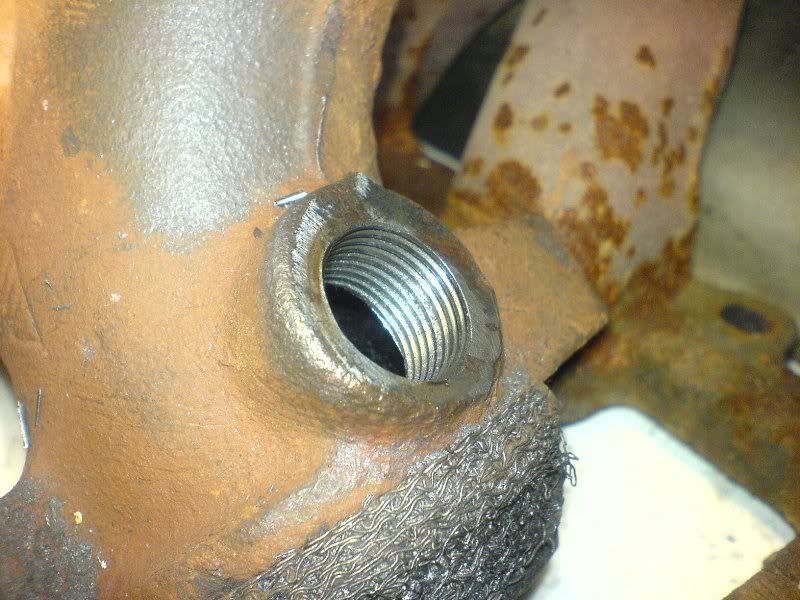
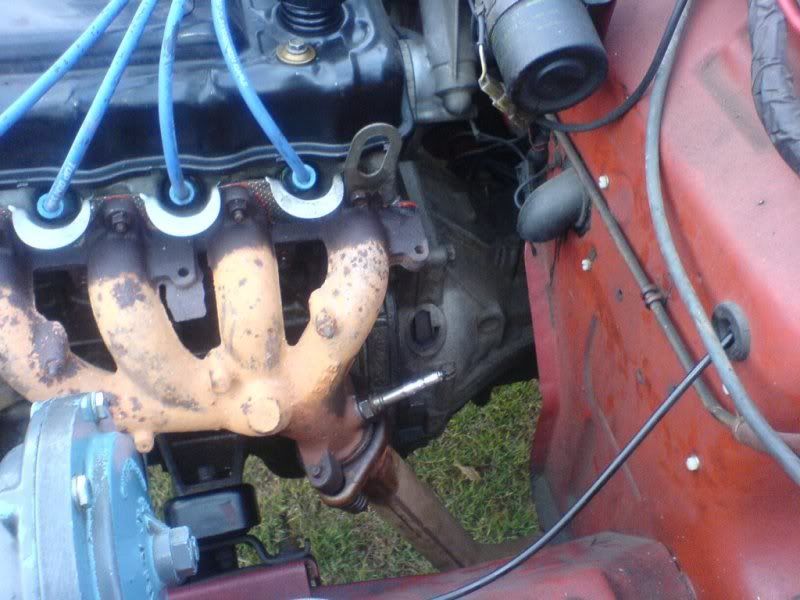
FYI drilling and tapping the stock exhaust manifold it pretty straightforward. I did one a while back when I installed my Megasquirt on a stock g13 with a g16 TBI manifold and injector setup.

Image

Image

Like you I used the position close to the flange to get the best mix of exhaust gasses.
Image

Image

FYI I narrowband oxygen sensor is only accurate at stoic mixtures, and on the lean side of the curve. If you are going to be messing with this stuff do yourself a favour and get a wideband sensor and controller. They are accurate across a wide range of AFRs and some even have data logging capability.

_________________
SJ50.4.LYF

 Profile  

Offline

Joined: Sat Jul 18, 2009 11:30 pm
Posts: 2372
Location: Ballarat, VIC

Post Posted: Tue Apr 13, 2010 12:22 am 
Reply with quote Top  
Damo:
Well I didn't see how a bit of research was going to hurt.
Installed on Sunday, did the testing and write up at work today (was a quiet morning).
Thx for the pics, my tap and die set didnt go that large, so I just used the welder.
But it seems like suzuki intended that spot for O2 sensors.
This was just a first stage test, am considerng going further in depth into this. The results from this little bit of work is quite promising.

BENJI, i have no fugging idea, havent done any research on LPG, except i know the AFR will be different, however an O2 sensor will provide you with similar results.

 Profile  

Offline
az supporter
az supporter
User avatar

Joined: Sat May 30, 2009 11:30 pm
Posts: 2770
Location: sunny coast
Vehicle: jimny

Post Posted: Tue Apr 13, 2010 12:28 am 
Reply with quote Top  
i have often thought about this idea before, especially when i was involved in bikes. you could use the lean/rich led kit from jaycar as a permanent install in to a sierra dash to see if its running ok all the time. good write up by the way!!!

 Profile  

Offline

Joined: Sat Jul 18, 2009 11:30 pm
Posts: 2372
Location: Ballarat, VIC

Post Posted: Tue Apr 13, 2010 12:41 am 
Reply with quote Top  
eldo wrote:
i have often thought about this idea before, especially when i was involved in bikes. you could use the lean/rich led kit from jaycar as a permanent install in to a sierra dash to see if its running ok all the time. good write up by the way!!!


Its a good idea, but I think it would read rich almost the entire time. Lean under engine braking

 Profile  

Offline

Joined: Sun Jun 07, 2009 11:30 pm
Posts: 301
Location: bris

Post Posted: Tue Apr 13, 2010 12:50 am 
Reply with quote Top  
really good right up dude

 Profile  

Offline
az supporter
az supporter
User avatar

Joined: Sat May 30, 2009 11:30 pm
Posts: 2770
Location: sunny coast
Vehicle: jimny

Post Posted: Tue Apr 13, 2010 12:52 am 
Reply with quote Top  
jdk81 wrote:
eldo wrote:
i have often thought about this idea before, especially when i was involved in bikes. you could use the lean/rich led kit from jaycar as a permanent install in to a sierra dash to see if its running ok all the time. good write up by the way!!!


Its a good idea, but I think it would read rich almost the entire time. Lean under engine braking
Im pretty sure you set the parimeters yourself

 Profile  

Offline

Joined: Sat Jul 18, 2009 11:30 pm
Posts: 2372
Location: Ballarat, VIC

Post Posted: Tue Apr 13, 2010 1:16 am 
Reply with quote Top  
Stay tuned for updates.

Possibly in the future, if i get permission from my boss at work, I can break a lot of rules and do some serious suzuki handling testing.
Put the zook (2" BL, 2" susp, 32" pedes) on the tilt table, CoG table, and tyre scales to fully calc the CoG in multiple ways.

Then do the dynamic testing on the test track.
The acceleromoter data would be quite interesting.

Get scientific data to prove the ride is crap

EDIT: it is mainly so i know how far she can go, the ground meters would be useful then

 Profile  

Offline
omnipotent being
omnipotent being
User avatar

Joined: Sun Jun 11, 2006 11:30 pm
Posts: 17216
Location: Pluto

Post Posted: Tue Apr 13, 2010 1:53 am 
Reply with quote Top  
get yourself into a decent wideband o2 sensor and meter kit, the narrow bands you are using arent much chop

14.7 is only a theoretical perfect as well, as your graph shows you need to go richer for power, nissvit did a good write up on jetting up a sierra carb for a lot more power on here, perhaps give it a go and compare your results?

 Profile  

Offline
az supporter
az supporter
User avatar

Joined: Mon Dec 11, 2006 10:30 pm
Posts: 34842
Location: East Radelayed
Vehicle: SV420+SV620 Vitara's

Post Posted: Tue Apr 13, 2010 3:33 am 
Reply with quote Top  
jdk81 wrote:
Stay tuned for updates.

Possibly in the future, if i get permission from my boss at work, I can break a lot of rules and do some serious suzuki handling testing.
Put the zook (2" BL, 2" susp, 32" pedes) on the tilt table, CoG table, and tyre scales to fully calc the CoG in multiple ways.

Then do the dynamic testing on the test track.
The acceleromoter data would be quite interesting.

Get scientific data to prove the ride is crap

EDIT: it is mainly so i know how far she can go, the ground meters would be useful then


awesome tech Armsup

just wondering what you do for a job if you have a ilt table, CoG table, and tyre scales... i'm guessing the tyre scales are like the flat patch scales used on race cars???

_________________
You're just hating because you don't understand

 Profile WWW  

Offline

Joined: Sat Jul 18, 2009 11:30 pm
Posts: 2372
Location: Ballarat, VIC

Post Posted: Tue Apr 13, 2010 12:58 pm 
Reply with quote Top  
flat patch scales?

the tyre scales are accurate scales you place under each wheel. this is used to confirm the CoG data.

I have probably said too much about where i work anyway.

Royce: the whole idea was because im a tight ass. I didnt want to spend anything on it.
Ill keep an eye out for wideband sensor and see if i can grab an oscilloscope from work

 Profile  

Offline
omnipotent being
omnipotent being
User avatar

Joined: Sun Jun 11, 2006 11:30 pm
Posts: 17216
Location: Pluto

Post Posted: Tue Apr 13, 2010 2:10 pm 
Reply with quote Top  
I believe 'some' cars come factory with the bosch version of a wideband, might be worth looking for

 Profile  

Offline

Joined: Sat Jul 18, 2009 11:30 pm
Posts: 2372
Location: Ballarat, VIC

Post Posted: Tue Apr 13, 2010 3:18 pm 
Reply with quote Top  
royce wrote:
I believe 'some' cars come factory with the bosch version of a wideband, might be worth looking for


Righteo I'll keep an eye out for 'some' car :P

I do agree, more accurate data would be very useful. Id like to know how stable the readings are at steady throttle and load etc.

Thx for your input

 Profile  

Offline
az supporter
az supporter
User avatar

Joined: Sat Jul 22, 2006 11:30 pm
Posts: 4661
Location: Brisbane

Post Posted: Tue Apr 13, 2010 4:25 pm 
Reply with quote Top  
SOme late model VW and Audi's have Bosch widebands apparantly. They are useless to you without a controller though.

_________________
SJ50.4.LYF

 Profile  

Offline
I live here!
I live here!
User avatar

Joined: Wed Oct 22, 2008 10:30 pm
Posts: 4673
Location: Katherine

Post Posted: Tue Apr 13, 2010 4:37 pm 
Reply with quote Top  
I have seen this product used quite effectively on kart engines

http://www.easitune.com.au/index.html

It would work on cars too.

 Profile  
Display posts from previous:  Sort by  
Post new topic Reply to topic  [ 17 posts ] 

Jump to:  


Who is online

Users browsing this forum: No registered users and 612 guests

You cannot post new topics in this forum
You cannot reply to topics in this forum
You cannot edit your posts in this forum
You cannot delete your posts in this forum
You cannot post attachments in this forum
Untitled Document


Untitled Document


Powered by phpBB © 2000, 2002, 2005, 2007 phpBB Group :: Style based on FI Subice by phpBBservice.nl :: All times are UTC + 9:30 hours